To Ensure a Healthy Work Culture, Start With Belonging
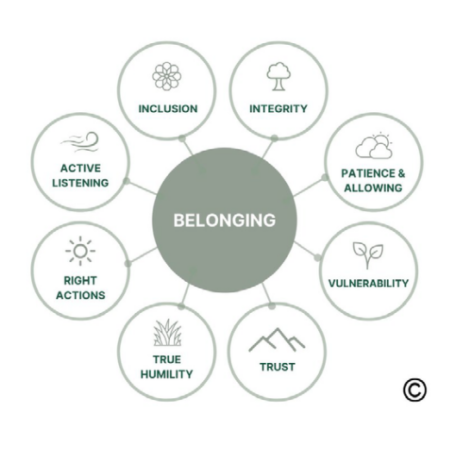
In our last installment, we spoke about taproot ventures’ frame for a healthy culture. We’ve found strong and resilient cultures place belonging in the center. Strong cultures create a voice for all employees and safe spaces for authentic honesty throughout the company ecosystem.
We base our teaching on our eight tenets: vulnerability, integrity, right action, inclusion, patience and allowing, active listening, trust, and humility.
It’s from this place that we define whether a culture is healthy or not. Our team has worked in the space of culture for more than 20 years, some of us as leaders inside organizations and some of us as consultants who are trained to cultivate healthy culture through brave conversations and facilitation of leadership teams and individuals.
As we worked in this space, we noticed that there were no tools to give organizations a deeper dive into their baseline. Our belief is measuring an organization’s health via the voices of ALL employees is vital to establishing a road map to inform the path toward developing a healthy culture.
Therefore, we developed the Culture Health Index, or CHI™, which we use to measure a company’s bottom line when it comes to culture. The CHI is rooted in our eight tenets, as well as the belief that a culture must be cultivated from the inside out, starting with belonging.
Building a healthy culture takes time. To understand where you stand as an organization, you need to go under the surface. Ask the questions of your entire organization, let go of old stories, and allow the data to inform what’s truly happening.
The deeper questions are often what’s overlooked because we try to check a box when it comes to culture and inclusion. This box-checking results in less retention, quiet quitting, and sometimes difficulty with recruiting and a negative company perception in social media. Some of the things we’ve read in reviews when we started with our clients include, “This company doesn’t put their money where their mouth is”; “They say one thing and do another”; “Leaders here think everything is fine but it really is NOT.”
Culture at an Organization is a Living, Breathing, Thing
Here are a few activities to try with your team to cultivate a healthy culture. Last week, we gave you a check-in/pulse check exercise. This week, we’re sharing a few additional activities that can build on those exercises:
1. The structure of your meetings can either invite people in or exclude them.
Try restructuring your team meeting to start with a check-in and a round of kudos. Encourage your team to come to the meeting with a positive experience with one of their teammates that week. What worked well this week, both on an individual and a team level? As you build trust, you can start to ask questions such as, “What worked? What didn’t? How do we iterate to be better next week?”
2. Pull your team together for a monthly meeting to ask the following questions:
-
- How do we keep growing as a team?
- Where are our opportunities?
- How do we continue to evolve?
This meeting happens from a place of curiosity. NO blame or shame. Leaders come wanting to learn. They don’t take anything personally; they open up to feedback and focus on active listening.
3. Most companies have a values statement. Some of those resonate and some don’t.
If your company has a powerful values statement, bring your team together and discuss what each value means to each of them. Go around the table and have a dialogue about how these values come to life in their day-to-day work (or how they don’t 😊). This is a wonderful exercise to give you as the leader a deeper understanding of what makes your teammates tick and what doesn’t through the lens of the company’s values.
What we’ve found interesting over the years is that every leader, and human for that matter, defines different words differently. This gives a wonderful opportunity to explore what’s important to people. If the values of your company aren’t clear, use the eight taproot tenets listed above. You could break this discussion into a few meetings or have them pick the one they’re best at and the one they would like to improve on. Again, deep learning comes from having these conversations with your team. It builds “connective tissue” which allows for you to have more efficient, effective teams overall.
We often tell our clients, “One hour of time building connection saves three hours of time in efficiency later.” When you all know each other better, it results in working more effectively and efficiently as a team.
This is the second installment of a three-part series on healthy culture written by taproot ventures’ CEO Stephanie Cocumelli and CVO and Founder Laura Wall Mansfield. Their first article, on making small changes in meetings to create a culture of belonging, can be found here. taproot ventures is a consultant member of Women in Retail.. Learn more about consultant memberships here.