AllSaints and John Varvatos Employees on What Black History Month Means to Them
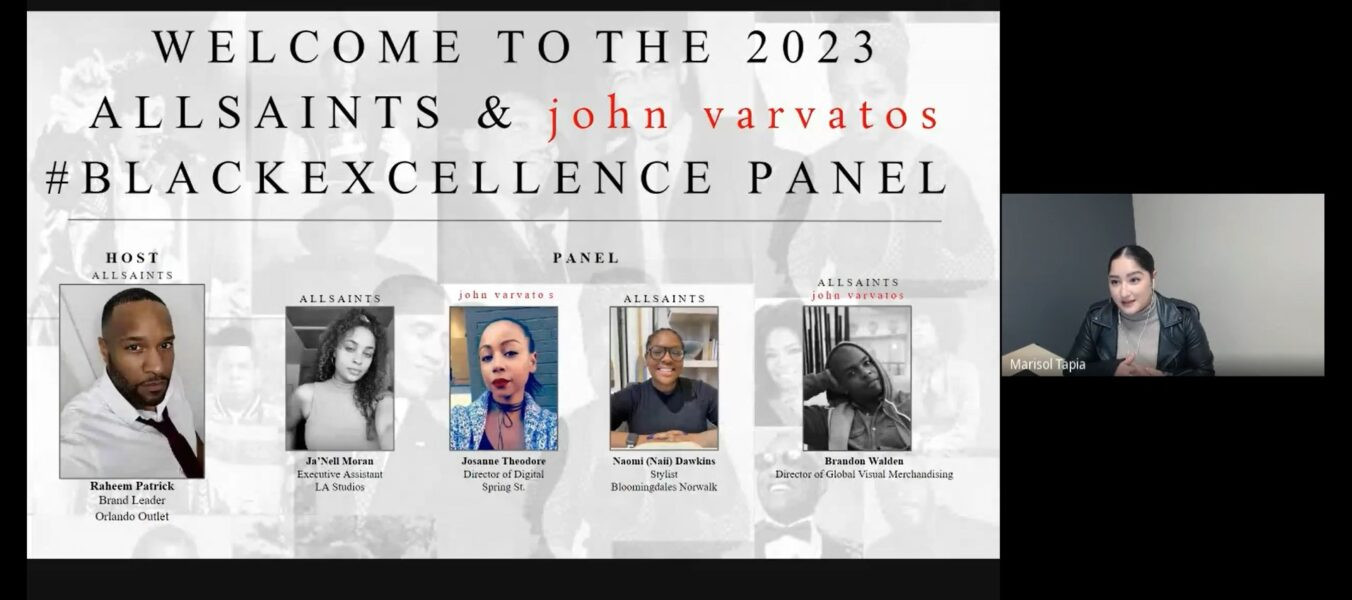
Last month, I reached out to Inner Circle readers, asking them to let me know what their companies were doing in honor of Black History Month. Misti Blasko, a Women in Retail Leadership Circle (WIRLC) advisory board member and former president of North America at AllSaints and John Varvatos, responded that several employees gathered on a panel in February to discuss what Black History Month and Black excellence means to them.
The panel was hosted and moderated by Raheem Patrick, a store leader at an AllSaints based in Florida, and featured Naomi Dawkins, an AllSaints stylist based in Connecticut; Ja’Nell Moran, the executive assistant at AllSaints’ Los Angeles studios; Josanne Theodore, a digital director at John Varvatos based in New York; and Brandon Walden, the director of global visual merchandising at AllSaints and John Varvatos, also based in New York. Here are some highlights from the discussion:
What does Black History Month mean to you?
According to Theodore, Black History Month “is an opportunity to pay homage to the Black community for the contributions they have made to American history. It is a celebration of the past, present and future. It is not just highlighting the struggles in our community but also our accomplishments.”
Walden agreed and added that Black History Month “is a moment for our community to truly show and represent that we are not a monolith. It is a good moment to celebrate that we are bigger than the box that you have put us in.”
What does Black excellence mean to you?
For Dawkins, who was raised by her grandparents, the narrative in her household from when she was very young was always, “‘You are Black excellence. You are resilient, you are strong, you are smart, you are articulate. And there is not one person in this world who can move you.’ And that is what I stand by. That is truly who we are as Black people. We are a resilient people. We are strong. We have been through so much, and how dare I let my ancestors down by [giving into] that narrative that we are nothing.”
How does race impact employment?
Walden said being a Black employee can be exhausting because of “code-switching”, when an underrepresented group (consciously or unconsciously) adjusts its language, grammatical structure, behavior, and appearance to fit into the dominant culture. “I hit the end of the day and I am so exhausted from code-switching back and forth … But you do it because that is what you have to do get ahead and sit in a leadership role. You have to speak multiple dialects of English in different ways and formats.”
Moran agreed and added that as a Black employee, you feel like you are always under a microscope. For example, “It is uncomfortable when people ask you questions about your hair. I understand the curiosity, but the questions get exhausting and at some point you don’t have to explain why you change your look. I understand that everyone is so curious about Black culture … and I don’t think the curiosity is coming from a mean place, but it doesn’t take away from the fact that it is exhausting.”
Finally, Theodore, who is a senior-level executive, addressed the fact that while there are a lot of Black people in entry-level positions in retail, “The higher you go, the fewer Black professionals there are, so it can be lonely. But it also feels like you are there representing the whole Black community. And that is a lot of weight to have on you.”
To view the full recording of the panel discussion, please click here.