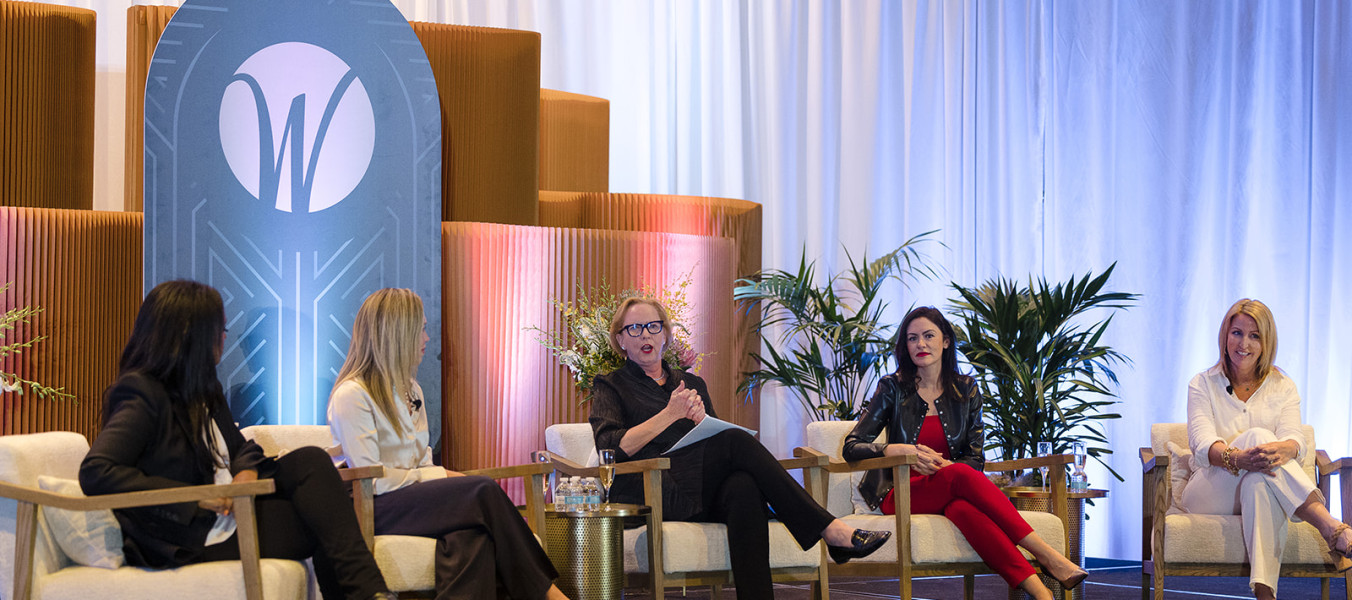
C-Suite Leaders Talk Superpowers, Career Pivots at WIRLS
One of the more anticipated sessions at the annual Women in Retail Leadership Summit (WIRLS) is the C-Suite Panel, which brings together four to five industry leaders to discuss the current business environment and how they’re positioning their businesses to succeed, the stories of how they rose to leadership roles, what they’re doing to empower the next generation of women leaders, and much more. This year’s session delivered on those lofty expectations.
Taking the stage for the C-Suite Retail Rockstars Panel were Brieane Olson, CEO, PacSun; Helen Aboah, former CEO, Urban Zen; Carey Ann Campbell, CEO, Southern Tide; and Nathalie Gerschtein, president, consumer products division, North America, L’Oreal. The discussion was moderated by Cindy Solomon, founder, CEO and president of the Courageous Leadership Institute.
Below are highlights from the conversation, with the panelists’ thoughts on various questions posed to them by Solomon.
What is Your Superpower, and How Has it Served You in Your Career?
Olson: “My superpower is intellectual curiosity. In order to stay relevant, particularly in the Gen Z market where I specialize, being naturally curious is a real advantage. An example of that is I spent 10-plus years at PacSun in the merchandising and design functions. So I thought I had a lot of expertise in product, but I felt I wasn’t a fully rounded executive in terms of how I was seen by other people, the board in particular, in terms of my knowledge of finance and accounting. So at age 40 I decided to go back to school, despite having two small kids at home. For nine weeks I did an executive program where you had to do all of the financial accounting. I realized how important it is to teach yourself at whatever age to constantly keep learning.”
Aboah: “My superpower is my ability to look at data, even if it looks like a scatter plot, and find that best line fit. I can immediately identify when nobody else can what that information is telling us and how do you use it to move forward. I’m able to connect the dots and create a straight path forward for myself and my teams.”
Gerschtein: “My superpower is optimism and resiliency. There is a quote that I love: ‘Life is not about waiting for the storm to pass or avoiding the storm, it’s about learning how to dance in the rain.’ It’s about embracing every opportunity and seeing every challenge as an opportunity. Sometimes you win and sometimes you learn. Failure is part of growth.”
Campbell: “Because I’m an introvert, I’m wildly observant and pay attention. I can quickly assess and understand a team’s strengths and weaknesses, and then assemble fantastic, collaborative teams.”
What Has Been a Pivot Point in Your Career, and How Did You Make That Decision?
Aboah: “I was at a company and doing really well, enjoying it, when an opportunity came knocking that I wasn’t expecting. There’s a strategy I use, and I use it in my own personal life, to remove emotion and any bias from my decision making. I get my close friends together, six of them. I assigned three of them the role of telling me why I shouldn’t take this job, and the other three were responsible for telling me why I should. These are very bright women — they can argue anything. Then I took that information and made my decision based upon it.”
Olson: “Early on in my career I decided to move to Europe to work for a large luxury brand there. It was a dream job, but it was very humbling. Despite all of my skills and the ability to get the job, I didn’t speak the dialect. Even though I was fluent in Italian, I didn’t speak the Venetian dialect. I realized I couldn’t break through from a culture perspective. I was the first American to ever work at that organization and I really wasn’t accepted.
“I’m a very resilient person and I’m very stubborn, so I kept my head down and worked at trying to develop the relationships over time with the factory workers. And over time I did end up progressing within the organization. But I quickly recognized that continuing to put more effort into what I thought was my dream job that I wasn’t going to see the advancement that I was hoping for in my career. So I left what was, quote unquote, my dream job and started a brand with another female entrepreneur. We ended up selling it a few years later, which ended up being a really important moment in my career.”
Gerschtein: “When you get at a crossroad and are wondering whether you should take a right or a left, whatever is done you have to think about what is going to make you happy. That is what matters. And makes you happy not only at work, but makes you happy as your whole self. Your career is not linear. I always wonder what is going to make me really happy because then I’m going to be good at it. Following your heart is something that we should be doing even more.”
Campbell: “I was 22 years old when this happened. I had a peer in the department store where I was working and she was promoted, and I was pissed. I had to go in and find out why it wasn’t me. As bold as I was at that time and super aggressive, I marched into my boss’ office and said, ‘Why wasn’t it me?’ And then I started saying, ‘she does this, she’s this and she’s this.’ He looked at me and said, ‘You’re better than that.’ Those were really powerful words to me. And then he said, ‘You should want her to do well. If she’s successful at this, then she paves the path for you and others.’ It instantly changed the way I looked at anyone who is promoted or any future boss — how I can support him and make him better?”
Women in Retail Leadership Circle members can watch all session recordings from the 2023 Women in Retail Leadership Summit here. Not a member? Apply today!