How This Meditation Expert is Bringing Mindfulness to Fortune 500 Companies
Ashley Wray began her business in meditation and mindfulness 12 years ago, calling it Mala Collective. The company makes different tools and props to help people connect to themselves, including online meditation courses. More recently, Wray has been working with C-suite executives and athletes to help them bring mindfulness into performance to prevent burnout and help them become better leaders. She’s worked with companies such as TED, JW Marriott, Mastercard and Google to bring mindfulness into employees’ everyday routines.
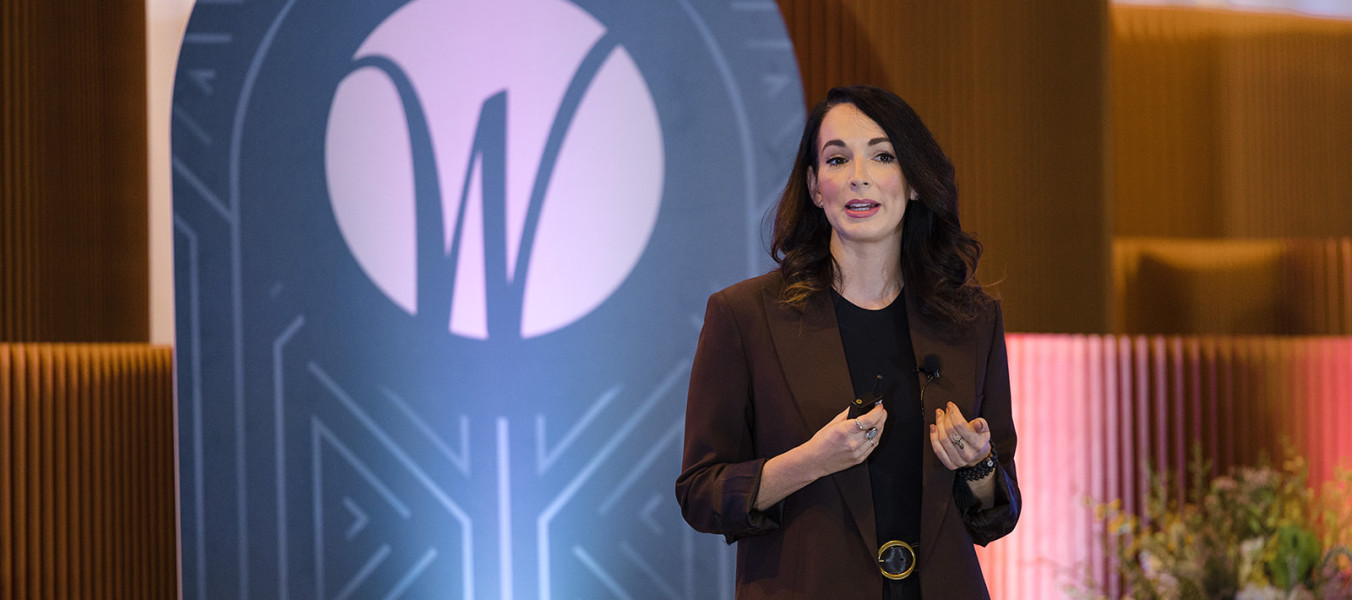
Wray spoke as a keynote at the Women in Retail Leadership Summit in April, guiding over 500 female retail executives through meditations and providing tips on how to bring mindfulness back to the office.
“How we speak to ourselves is often reflected in how we speak to others. So if we’re in positions of leadership and we’re talking down to ourselves, how does that manifest in our external communications with our teams, with our partners, with our kids, with our friends?” she said.
She suggested we reframe meditation as a practice of self compassion. The point of meditation, Wray said, is not to eliminate all the thoughts, but to create space between those thoughts. That creates space for “aha” moments, something the executives she works with attribute to mindfulness.
“If you want to call it intuition, God, the universe, the cosmos — whatever language you want to use — when we create space between our thoughts, we can receive those big ideas,” she said.
Some of the ways she’s helped employees from Fortune 500 companies add meditation and mindfulness to their daily habits include:
- Building out rooms unique to meditation, like she’s doing with Google;
- Motivating and encouraging employees before a big presentation;
- “Decompression Days” given to employees after a big sprint to reflect on what worked well, rather than a post-mortem.
Wray offers these tips for how to start a meditation practice:
- Tie it to a habit you’ve already built. Wray said that allows us to piggyback off something we already have in our routine. Personally, she makes her French press coffee each morning, meditates, then drinks her coffee. Other examples include tying a meditation to a morning walk, or meditating right after brushing their teeth.
- Start small. Wray said you don’t have to sit for 20 or 30 minutes and meditation. You can start with one, three, or five-minute sessions. “It can really be small doses that allow for a moment of reconnection,” she said.
- Have self-compassion. She finds that people typically fall off the routine after three meditative sessions because they get to a place of self-judgement. Being really loving and kind to yourself on the days you fall off are the key to getting back on track.
Wray’s full keynote — complete with two guided meditations — is available on-demand for Women in Retail members. Not a member? Apply today!