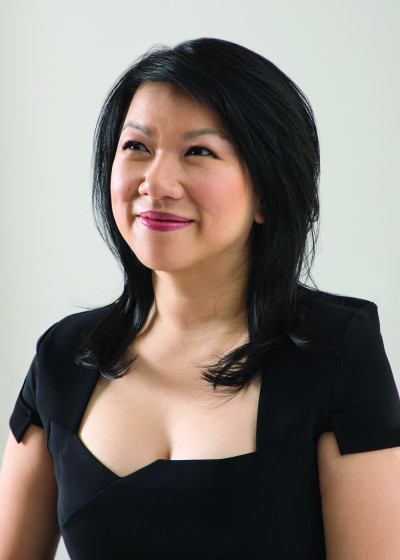
Game Changer: Shan-Lyn Ma, Founder and CEO, Zola
This article originally appeared in the cover story of Total Retail’s Summer issue, Game Changers. (Total Retail is the sister publication of Women in Retail Leadership Circle.) In this excerpt from the cover story, Shan-Lyn Ma, co-founder and CEO of Zola, a company reinventing the wedding planning and registry experience with a free suite of planning tools, is interviewed on topics ranging from her inspiration to launch the company to the retail technologies she’s keeping a close eye on to what her leadership style is.
Total Retail: Where did you get the inspiration to launch your company?
Shan-Lyn Ma: I always wanted to be an entrepreneur. In 2013, after working at Yahoo and then at Gilt Groupe, I felt like it was my time. It also happened to be the same year that I was going to a lot of weddings. Everyone has that year in his or her life, right? That year when nearly every weekend is spent at a friend’s wedding. So I was buying a lot of wedding presents off of my friends’ registries at big department stores, and I saw firsthand how terrible the shopping experiences were. They were impersonal, fragmented and not mobile-friendly. I met with my former co-worker and friend, Nobu Nakaguchi, who completely agreed, remembering how bad the registry experience was when he got married years before. We realized that with our backgrounds in design, technology and e-commerce, we were well positioned to reinvent the antiquated wedding registry business. And today, Zola is the fastest-growing wedding company in the country.
TR: What was the “aha!” moment when you realized you might have a successful business?
SLM: Nobu and I spent day after day building our prototype, testing it with hundreds of engaged and newlywed couples, going back to the drawing board given their feedback, and testing again. During one of my sessions, a bride started crying in front of me. When I asked her why, she said that she didn’t know that she was “allowed” to register for the things we were offering. Her emotional reaction definitely was an “aha!” moment for us. Plus, a lot of our friends who were getting married saw our prototype and were practically begging us to launch, too.

TR: What was the pivotal marketing campaign or channel that really catapulted the business in its early days?
SLM: In the early days of Zola, both Nobu and I really relied on our personal networks. Many of our early adopters were through our friend groups. They were all incredibly supportive, and (thankfully) many of them were getting married. We also targeted graduate schools because we knew that grad students were often early tech adopters, around marrying age (or attending a lot of weddings), and could be prospective job candidates for the future.
TR: How are you planning to scale your business for future growth?
SLM: For three years we stayed heads-down focused on creating the best registry experience for couples and guests. However, the whole time our couples were asking us, “What’s next?” The No. 1 request that we heard over and over again was to offer wedding website designs as personal, beautiful and intuitive as our registry.
In 2016, Nobu and I decided we were ready to scale and take on the $300 billion global wedding industry. We launched Zola Weddings earlier this year, an entirely free suite of wedding planning tools including wedding websites, a customizable checklist, guest list manager and, of course, registry. Before this launch, we were meeting couples about seven months before their wedding. Now, we’re able to serve couples from the day they get engaged through their first year of marriage and even after. Since we’re the only wedding company monetizing through e-commerce, we’re the only wedding company able to provide all of these planning tools to our couples in one place, all for free.

TR: Can you tell us about a successful initiative for Zola that was launched in the last year?
SLM: Zola Weddings was an incredible initiative and successful launch that took every member of our team to accomplish.
TR: What are your goals for the business going forward?
SLM: Our long-term goal is to create the best wedding planning and registry experience for our couples and their guests. We’re on track to have a phenomenal 2017.
TR: What types of retail technology are you watching closely and/or thinking of implementing?
SLM: We offer our couples and guests an amazing experience, from merchandise selection to best-in-class customer service. We also have an incredible in-house tech team, so we don’t often outsource projects. Right now, we’re very focused on brand awareness to ensure that couples and guests know about Zola in the first place. We’re always thinking about how to convert customers once they land on Zola.
TR: Tell us about your hiring strategy.
SLM: In addition to attracting top talent, we have a strict “No Asshole” policy at Zola. To that end, we make sure every candidate is the right culture fit. You sit next to your co-workers every day, so a great attitude is just as valuable to us as a fantastic work ethic.

TR: Tell us about your leadership style.
SLM: One of the best pieces of advice I’ve ever received came from my co-founder and Zola’s chairman, Kevin Ryan. He said that as a CEO, “your job is to become irrelevant.” If you’re able to hire the right people to do the things you always felt like you were doing alone, you’ve built something bigger than yourself — an enduring company. I try to bring a hands-off approach to my team, letting them explore, discover and shape their skills. I want every person that works at Zola to be excited to learn, and my dream is for every person that moves on to feel confident enough to be able to start his or her own company one day. But of course, I never want them to move on from Zola!
TR: What can traditional retailers learn from your business?
SLM: We’re always testing at Zola and adapting our product to the needs of the market. We also conduct surveys with both users and nonusers to learn how we can improve. For example, in the early days, I had a hypothesis that modern couples no longer wanted traditional gifts as much as they wanted cool experiences to share with each other. I was only partially right — couples actually want it all. They want the experiences, but they also want classic home upgrades, like kitchen appliances and soft sheets, and they want money to build a life together. So we quickly expanded our product offering, and now sell over 50,000 gifts from over 500 brands. Traditional retailers tend to have a hard time adapting quickly, but it’s important to listen and be nimble.
TR: What technology systems and service providers are in your technology stack?
SLM: Two great systems we’re currently using are React and Angular.