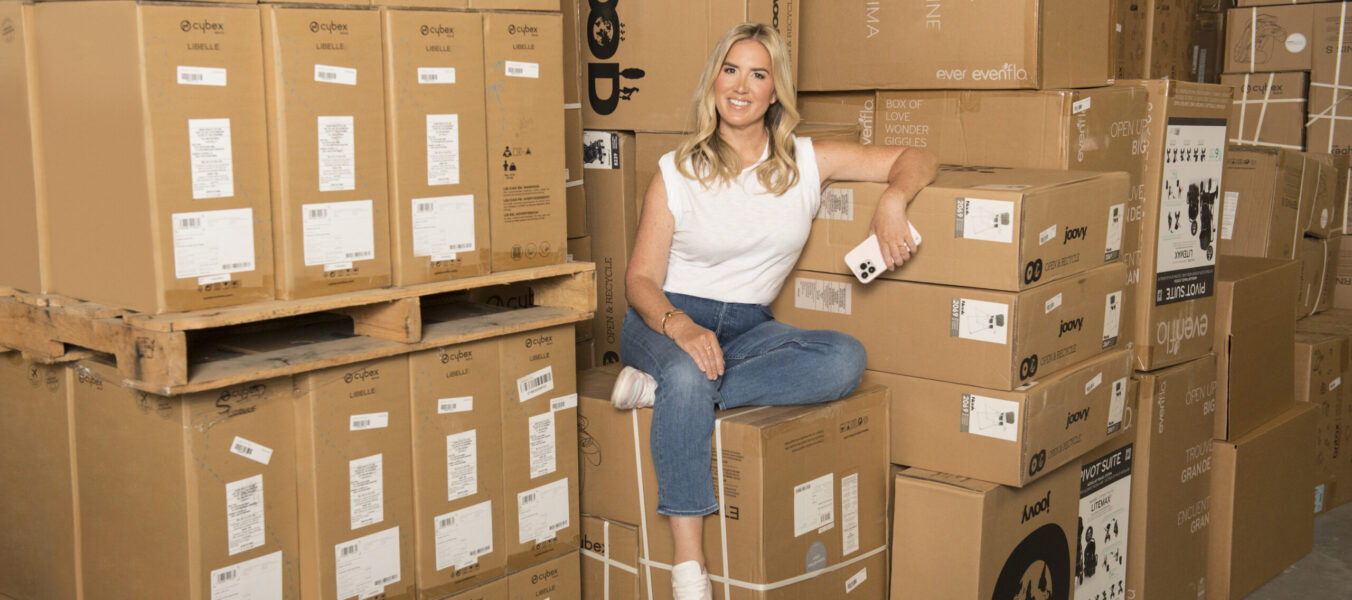
How Baby Gear Recommerce Marketplace REBEL is Tackling the Returns Crisis
Emily Hosie will be the first — but certainly not the last — to tell you that there’s a returns crisis in America.
The crisis is especially glaring in the world that Hosie first discovered when she became pregnant — the world where safety is the highest standard and no one wants to buy anything for their baby that has the slightest chance of malfunctioning, for obvious reasons.
It’s often more costly for retailers to receive returned items, check them for quality, repackage them, and redistribute them into circulation than it is for them to dump the unused products into a landfill, which Hosie found unacceptable.
“That’s just the norm,” she said in an interview. “Most full-price retailers don’t think of the end-of-life product. They haven’t built the supply chain necessary to do all of those things.”
Refusing to accept that as the answer, Hosie took the experience she had gained working for off-price retailers TJ Maxx and Saks OFF 5TH and founded REBEL (formerly Rebelstork) in 2020 with the aim to partner with retailers to divert landfill-bound baby gear in a way that would save everyone money.
Building her own proprietary technology that can mass process returns at scale for re-commerce, Hosie and her team at the Toronto-based REBEL act as an extension of the operations team of brands and retailers. When a customer returns an unused product — REBEL uses the term “open box” — to a brand or retailer that works with REBEL, that product is then directed to REBEL, where it’s checked for quality, re-boxed, and sold on Fromrebel.com at a discount.
The “open box” distinction is important, especially in the world of baby gear. “You’re not sacrificing quality in any shape or form, but you are saving a lot of money,” Hosie said. “The item that was purchased, it’s never used, simply returned.”
The White Space in Returns
The baby products market is expected to reach $611.4 billion by 2033, according to a new report by Dimension Market Research. It’s a highly competitive market, with global players like Johnson & Johnson, Procter & Gamble, and Unilever offering the big purchases families can’t go without, such as a car seat, a crib, a stroller or a bassinet. A middle-income family can expect to spend an average of $18,270 a year on a child, according to What to Expect, a website providing content on all things pregnancy, children and parenting.
At the same time, consumer returns across the retail industry total up to $890 billion, according to a December 2024 report by the National Retail Federation (NRF). On average, retailers estimate that nearly 17 percent of their annual sales in 2024 will be returned. Because of this, 66 percent of retailers surveyed by the NRF said they started charging customers for returns over the last 12 months, with 44 percent of survey respondents citing increased costs of processing those returns.
Here, Hosie sees two problems: One faced by the consumer — the cost of acquiring all the baby gear, which is rising thanks to inflation — and one faced by the retailer, which either incurs the cost of returns, stockpiles unsellable baby gear in a warehouse, or spends money tossing the products in a landfill.
Enter REBEL. According to its 2024 recommerce report, the company has kept over 200,000 items out of landfills by reselling them at up to 80 percent off the retail price. Hosie said her team processes over 70,000 unique SKUs every week, and the companies that partner with it, such as Graco, Baby Jogger, and Dorel Juvenile, not only save money, but generate new revenue because they’re receiving a portion of each REBEL sale.
Hosie said she’s helping retailers and brands reimagine their supply chains, something that takes time and isn’t easily replicated.
“You can only imagine how slowly it takes mass retailers and large brands to change; it’s like moving the Titanic,” she said. “I think retailers and brands realize how complicated it is; what we built is so hard to be duplicated because of the volume.”
Companies’ Sustainability Priorities Plummet
Sustainability had its moment in the sun — as one sustainability expert put it, there was an ESG (environmental, social and governmental) “golden age” from 2020-2023 — with retailers and brands onboarding chief sustainability officers, voluntarily reporting emissions targets, actively working to reduce their environmental impacts, and more. Today, with 10 of the hottest years on record directly behind us, sustainability as a priority has plummeted. A 2024 Bain & Co. report found that CEOs were rating sustainability lower on the prioritization list, below topics such as inflation, disruptive technology, and geopolitical uncertainty. Additionally, CEOs are realizing that meeting the sustainability commitments they originally pledged was going to be more difficult or take longer than expected, with nearly a third of companies behind on their Scope 1 or 2 emissions reduction targets.
“The transition to a sustainable world is following a familiar cycle,” said Jean-Charles van den Branden, Bain’s global sustainability practice leader, in the report. “What began a few years ago as boundless excitement has given way to pragmatic realism. As the challenge of meeting bold commitments becomes clear, many companies are rethinking what’s achievable and on what timeline.”
Only 18 percent of fashion business leaders named sustainability a top risk for growth in 2025, down from 29 percent from 2024, according to McKinsey & Co.’s State of the Fashion report for 2025. And over eight in 10 sustainability experts in North America said in a 2024 GlobeScan/ERM Sustainability Institute Leaders survey that there’s a backlash against the sustainability and ESG agenda. To cite a few examples: Tractor Supply Co. announced in June it would withdraw its carbon-emissions goals, and Nike cut its Sustainable Innovation team in late 2023; Unilever walked back its pledge to halve its use of virgin plastics by 2025, instead aiming to reduce it by a third by 2026, according to Bloomberg.
Hosie has also noticed companies shifting their sustainability goals. “A lot of companies thought, ‘We’ll just do it in house,'” not realizing how challenging many of these green initiatives are. “Oftentimes its not in the company’s DNA to be able to execute on these initiatives.
“Companies are realizing it’s hard,” Hosie continued. “Once you’re set in your ways, once the supply chain has been built, it’s really hard to change that and change it quickly.”
As the largest returns recommerce marketplace for baby gear in North America — and the only one in the industry that’s Certified B Corp — Hosie said she’s presenting those companies with a first-of-its-kind solution in reverse logistics.
“We’re truly extensions of our retail and brand partners’ operations teams,” noted Hosie. “They’re trusting us with their returns recommerce. It’s the technology, the labor, the facility space … it’s a whole other business model.”
The Conscious Consumer
The U.S. recommerce market is expected to reach $276 billion by 2028. It turns out, customers are actually shifting their spending toward companies with ESG initiatives. A 2023 NielsenIQ and McKinsey & Co. study found that products that had one of six ESG classifications — related to animal welfare, environmental sustainability, organic farming methods, plant-based ingredients, social responsibility, or sustainable packaging — were more popular than those that didn’t have any of those ESG classifications.
Hosie said she’s seeing that play out amongst parents, particularly Gen Z and millennial parents, who are more conscious about the environmental impact for the next generation.
“They’re about to give birth to a child and they’re imagining what the planet is going to be like,” Hosie said, adding a consumer has the added challenge of deciphering what is “real” environmental impact and what is just greenwashing.
“When we talk about our impact, it’s fully transparent and it’s honest,” Hosie said, adding REBEL has prevented 12 million pounds of baby gear from entering landfills annually.
Long term, Hosie said REBEL is surging, onboarding many new partners and scaling into other categories. It entered the home category in the fall. REBEL is backed by several venture capital funds, including Serena Williams’ Serena Ventures, and received $18 million in Series A funding in September.
This article has been updated to reflect the company’s new name as of March 11, REBEL.