Why Agentic Commerce is Becoming a Retail Imperative
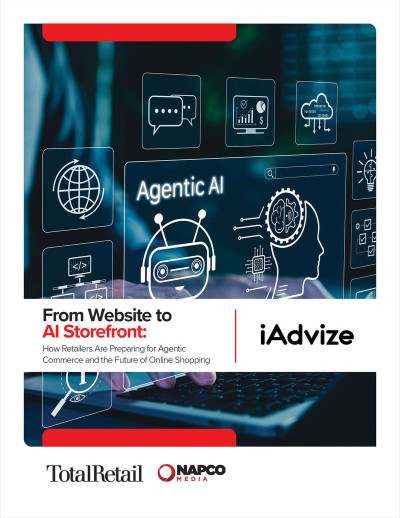
The traditional e-commerce website, defined by search bars, filters and static product grids, is increasingly misaligned with how consumers want to shop. According to a new report from Total Retail, From Website to AI Storefront: How Retailers Are Preparing for Agentic Commerce and the Future of Online Shopping, consumers now expect to describe their needs in natural language and receive intelligent, guided responses that remove friction from the buying journey. This shift is giving rise to agentic commerce, a model in which artificial intelligence agents actively guide product discovery, comparison shopping, and purchase decisions on the consumer’s behalf. (The report was commissioned by iAdvize, the leader in generative AI for e-commerce.)
Why is agentic commerce being positioned as a game-changer for digital commerce? Despite decades of UX optimization, traditional e-commerce conversion rates remain stuck at 2 percent to 3 percent, a figure that has barely moved in years. The report identifies three forces breaking the legacy model: low conversion rates, rising customer acquisition costs, and decision fatigue caused by endless product choice. In an environment where paid traffic is more expensive than ever, retailers can no longer afford leaky funnels or friction-heavy experiences
What is Changing: From Browsing to AI-Led Journeys
Agentic commerce represents a shift from UX-driven browsing to AI-led journeys. Rather than forcing shoppers to hunt for the “right” product, AI-powered storefronts interpret intent, ask clarifying questions, and proactively surface relevant options.
Early data suggests adopting agentic commerce is already delivering measurable impact. Brands integrating conversational and agentic AI into their websites report up to 25 percent of total digital sales influenced by AI-guided sessions, with AI-assisted interactions converting at meaningfully higher rates than traditional site traffic.
For example, retailers deploying iAdvize’s AI shopping assistant are seeing an average 15 percent incremental revenue lift from AI-guided experiences, driven by higher engagement, confidence and purchase completion.
Why AI Storefronts Are Gaining Attention
The report outlines four core benefits AI storefronts unlock:
-
Human-like engagement at scale: AI shopping assistants proactively engage consumers with contextual prompts and recommendations, increasing time on site and emotional connection.
-
Conversion and revenue lift: Unlike static recommendations, AI adapts in real time, helping shoppers overcome hesitation and move toward purchase.
-
Agility without a full redesign: AI assistants can be embedded into existing product, category and checkout pages, avoiding costly re-platforming efforts.
-
Readiness for AI-agent traffic: As platforms like ChatGPT increasingly influence discovery, retailers must ensure their product catalogs are machine-readable and actionable for both human and AI shoppers.
Case studies reinforce these benefits. For example, Sideshow Collectibles achieved an 8x increase in conversion rate among AI-assisted users, while Mademoiselle Bio saw assisted visitors convert six times higher than organic traffic and lift average order value by 13 percent. In addition, Mon Lit Cabane generated €1 million in incremental revenue, with AI-assisted shoppers spending 30 percent more on average.
What Retailers Should Do Next
For retail executives, the takeaway isn’t theoretical, it’s operational. The report recommends leaders immediately assess whether their storefronts still rely primarily on filters and manual search, whether shoppers can interact using natural language, and whether experiences adapt dynamically by user, intent and journey stage.
Practical next steps include:
- Deploy AI guidance at friction points such as product detail pages, sizing questions and checkout.
- Shift key performance indicators beyond traffic to “guided conversion,” measuring revenue influenced by AI-assisted sessions.
- Prepare product data for AI consumption, ensuring catalogs are structured for both internal AI tools and external agent-driven discovery.
- Start small and scale fast, piloting AI storefront capabilities that can launch in days rather than months.
The Bottom Line
Agentic commerce isn’t a future-state concept; it’s already reshaping how consumers discover, evaluate and purchase products online. Retailers that treat AI as a core storefront layer, rather than a support add-on, are seeing immediate gains in conversion, revenue and loyalty. Those that delay risk falling behind as consumer expectations continue to reset around speed, relevance and guided decision-making. As the report concludes, the winners in the next era of e-commerce will be those that allow AI to listen, guide and act, turning their websites into intelligent storefronts built for how people shop today.
This article was originally published on Total Retail and has been republished with permission. Women in Retail Leadership Circle is the sister brand of Total Retail.