How Meera Bhatia is Leading Fabletics Into its Evolutionary Era
Meera Bhatia is spearheading an evolution. As one of the few women of color in retail’s C-suite, she’s spent decades navigating male-dominated spaces like retail and technology with focus and intentionality. Now, as president and chief operating officer of Fabletics, she’s guiding the membership-based activewear brand through its most transformational year yet — steering international expansion, growing Fabletics’ nascent wholesale business, and leading the charge to adopt artificial intelligence with calm precision.
In an exclusive interview with Women in Retail Leadership Circle (WIRLC), Bhatia used two words to describe Fabletics’ current state: evolving and energized.
“If you come into our offices, you’re going to see there’s an exciting buzz,” Bhatia notes. “Teams are fired up about what we’re doing. Everybody loves testing new ideas, collaboration is at an all-time high; it’s a really fun place to be right now.”
Next week marks the launch of a Fabletics store in Mexico City, the latest of a hopefully long line of international store expansions for the 12-year-old brand. Fabletics is opening or has opened at least 20 new stores in the U.S. to surpass 100 locations; its wholesale channel has taken off in places like Nordstrom and Scrubs & Beyond (currently only available online); and the brand is on track to reach $1 billion in revenue within the next year.
“It feels like a really big moment for the brand,” says Bhatia.
For Bhatia — who was named president in addition to COO roughly 90 days ago, succeeding Ashley Kechter in the role — it’s not about hitting that $1 billion mark in sales. Or $2 billion. Or taking the company public.
“On the one hand, it’s a great vanity metric,” Bhatia acknowledges. “It’s a big number and a big deal. There’s not a lot of retail companies that make it to that size and scale.”
On the other hand, Bhatia doesn’t want to be overly distracted by a goal like that.
“It’s just another number on the way to keep growing,” she notes. “The end goal is not to be a $1 billion company, a $2 billion company; it’s to build an everlasting brand and a company that’s here for the ages.”
The Evolution of Athleisure
Once upon a time there was a world where athleisure didn’t exist on every street, in every coffee shop, behind every Zoom screen. An extremely unofficial poll of my friends credited Fabletics with coining the term “athleisure” — competitor lululemon, founded more than a decade before Fabletics, came in close second. And while the idea of activewear for everyday use has proliferated the market, Fabletics Co-Founders Don Ressler and Adam Goldenberg proposed an alternative to the competition: cute, fashion-forward activewear that could take you from the gym to the coffee shop without costing hundreds of dollars, using a membership model (leggings for its members cost less than $20; nonmembers pay $80-$90).
Athleisure came to a fever pitch at the height of the COVID-19 pandemic. Bhatia recalls that time being a boon for Fabletics’ sales, followed quickly by a scramble to keep products on the shelves amid shipping and supply chain issues. Once people started returning to the office, however, there was a new desire for clothing that was comfortable but work-appropriate.
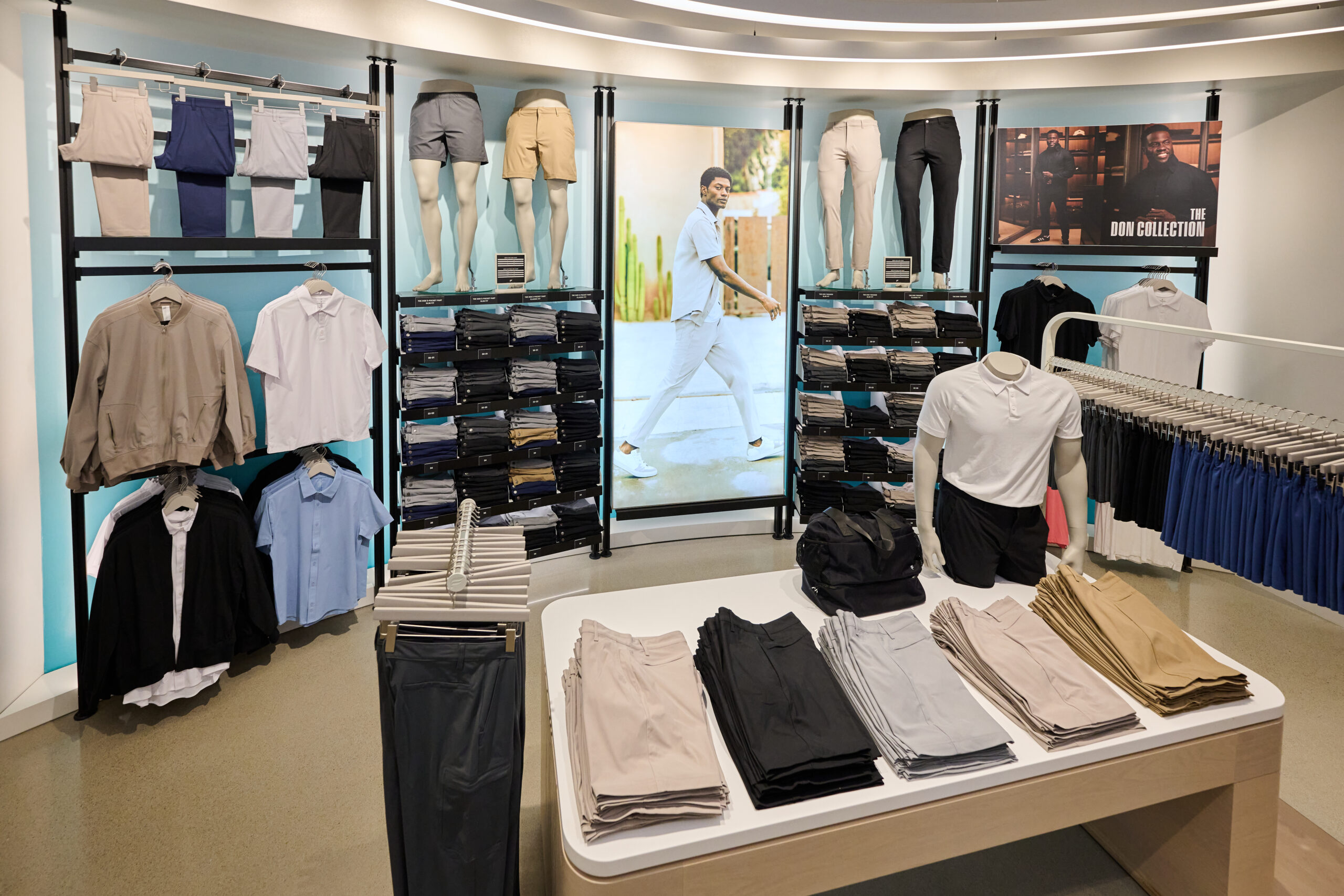
Fabletics introduced a line of men’s clothing designed to be worn at the office and when working out. | Credit: Fabletics
Bhatia says Fabletics has leaned into that trend, offering looser-to-body fits, casual styles that you can wear to the office and to the gym. Its Don collection for men offers jackets, shirts, shorts and pants — “clean enough for the boardroom, made to move for the course” reads one description of the Don pant — and it introduced more wide-leg pants for women as a work-appropriate alternative to tight leggings.
As president and COO, Bhatia works very closely with Ressler and Goldenberg, who she said are both “very involved” in the company. She’s not new to the world of founder-led businesses, and she said they trust her to run things.
“Nobody has more skin in the game than them,” Bhatia notes, adding she views her role as the leader amplifying their vision.
A Tech-Driven Leader
That vision starts with technology, and technology is at the core of everything Bhatia does. She was one of three women in her mechanical engineering class at the University of Pennsylvania. She graduated and entered the technology workforce at PwC, eventually landing jobs at major tech companies like Microsoft, Hotels.com, and LinkedIn.
“What I like about technology is that it’s very innovative, very fast moving, there’s a lot of real-time feedback around it, which is satisfying,” Bhatia says. With a career pivot to retail in the late 2010s — and a lifelong passion for fashion and athletics — Bhatia saw the opportunity to take that kind of thinking and apply it to an industry that had room to innovate the customer experience.
Bhatia says she was drawn to Fabletics because it was a company disrupting modern retail with a more tech-driven approach. Fabletics is primarily a direct-to-consumer, digital-native activewear brand that operates on a membership model. While the company is expanding into wholesale and brick-and-mortar stores, the membership model remains Fabletics’ core revenue generator. In fact, it boasts over 2 million “VIP members” who get access to discounts, perks and a monthly credit.
Fabletics’ membership model is successful for a reason, according to Bhatia. The brand is able to collect all sorts of data on sizing, preferences and more, allowing it to be predictive in its merchandising and product inventory, which in turn delivers very low return rates and keeps excess inventory to a minimum.
Beyond the data, Fabletics prides itself on talking to its VIP members, who they invite to the brand’s Los Angeles corporate office. The brand gives members sneak peeks at new designs, solicits feedback regularly, holds “Meet the Member” events with staff, hosts workout classes, and more. Fabletics was also an early adopter of leaning into influencers as part of its marketing model. The brand has become adept at selecting the right celebrities to attach to the brand, including Kate Hudson (an investor and former spokesperson for the brand), Kevin Hart (the face of Fabletics Men), Lizzo (co-creator of Fabletics’ Yitty shapewear brand), and more recently, Khloé Kardashian and Becky G.
As COO, Bhatia had been overseeing many of these functions already. As newly named president, she’s taking a deeper dive into a company growth strategy that she was already driving, with more functions consolidated across what she oversees. One of her focuses as president is collaboration and consistency across all of Fabletics’ channels; another is getting the entire company on board with using AI internally and eventually when interacting with customers.

Fabletics was an early adopter of using influencers.
“I personally feel like we have an obligation to have all of our employees educate themselves on how to make them more productive” with AI, Bhatia says. “Whether we like it or not, this is happening. Workers who use it are going to be at an advantage.” Fabletics employees are being trained on basic prompting, encouraged to find ways of automating repetitive tasks, presenting AI use cases, testing AI chat communications, and more.
Bhatia is also spearheading the pivot into wholesale, strategically investing in systems and processes to evolve from a purely D-to-C business. She’s purposely not rushing the process.
“We want to make sure that anything we do we are doing well and we’re not going into a thousand different retail stores at one time so we can do things really well as we expand,” says Bhatia.
‘I’ve Never Known Anything Else’
The fine point that must be made when looking at Bhatia’s success at Fabletics — and in her career across the retail and technology industry — is that she embodies a unique trifecta: a woman in the C-suite, a woman in tech, and a leader of color. There aren’t many others in retail or tech that look like her.
When I point that out to Bhatia, she pauses, then shrugs as if I’ve just said the most obvious thing in the world.
“I’ve never known anything else,” says Bhatia. “It could never have been something that I really let bother me because otherwise I wouldn’t be doing the things that I love.” That drive and ambition — combined with saying yes to difficult work challenges, even if it made her uncomfortable — is what Bhatia attributes to her career success.
“My No. 1 thing is ‘just say yes,'” she advises. “Everybody talks about imposter syndrome; that’s very real for a lot of people still, but recognizing that those are going to be the situations that are going to accelerate your career is really important.”
Bhatia is highly attuned to the feeling of discomfort. She’s of the belief that if you’re settled in a job and comfortable, it might be time for something new.
“The only way you get better and get the next thing is if you have a growth mindset,” Bhatia advises. “If I look around and I’m not learning anything new in my job? It’s time to make the change.”
In her current role, Bhatia is doing what she can to inspire more women to embrace a similar growth mindset, so that one year, five years, or a decade from now there will be more women like her in leadership positions.
“I’m frustrated that in some ways it’s so much better than when I started, but it’s not where it needs to be,” Bhatia says. “I can continue to plug away and build the career that I have and hope that that inspires people.”
Meera Bhatia will be speaking on a panel about retail leadership at Women in Retail Leadership Circle’s On the Road | Los Angeles event on Nov. 4. Register now to hear her speak.